

Description
What is the GI-MAP Stool Test?
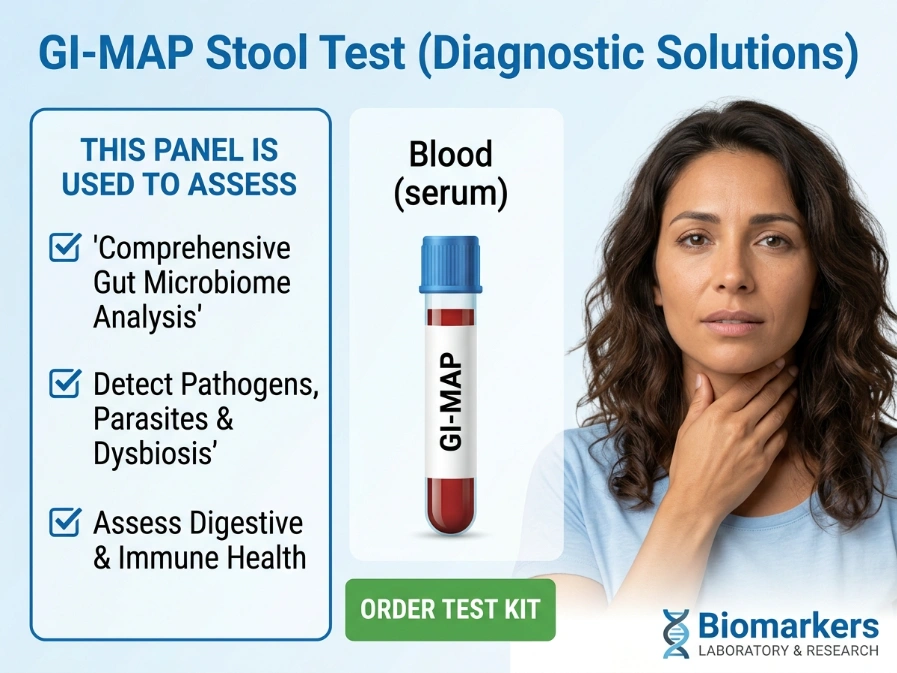
The GI-MAP Stool Test from BiomarkersLabs.com is a comprehensive quantitative stool analysis developed and processed by Diagnostic Solutions Laboratory — one of the most widely used and clinically validated functional gastrointestinal testing platforms in functional and integrative medicine. GI-MAP stands for Gastrointestinal Microbial Assay Plus, and its defining analytical distinction from all culture-based or conventional stool analysis methods is the use of quantitative polymerase chain reaction (qPCR) DNA technology to identify and precisely quantify gastrointestinal microorganisms, pathogens, virulence factors, and intestinal health markers directly from a single stool specimen. qPCR technology detects microbial DNA with exceptional sensitivity and specificity — identifying organisms that culture-based methods routinely miss due to fastidious growth requirements, anaerobic conditions, or low abundance — and reports results as quantitative DNA values (copies/mL or copies/swab) rather than qualitative positive/negative outputs, enabling precise interpretation of abundance and clinical significance. The GI-MAP is one of the most comprehensive single-test assessments of gastrointestinal health available in clinical practice, covering bacterial pathogens, viral pathogens, parasites, H. pylori with virulence factors, gut dysbiosis, intestinal immune function, digestive capacity, and intestinal permeability markers in a single stool sample. Specimens are processed through Diagnostic Solutions Laboratory’s CLIA-certified USA laboratory network. Results are delivered to your secure BiomarkersLabs.com practitioner portal within 10–14 business days of specimen receipt. Available in USA only. Licensed practitioners only.
The clinical rationale for the GI-MAP’s comprehensive multi-domain approach to stool analysis reflects the complexity of gastrointestinal health — a system that simultaneously involves microbial ecology, immune function, digestive enzyme activity, mucosal barrier integrity, and inflammatory status, all of which interact bidirectionally and none of which can be fully understood in isolation. A patient with chronic IBS-like symptoms, for example, may have concurrent H. pylori infection with the more pathogenic virulence factor CagA, SIBO-promoting gut dysbiosis, elevated calprotectin indicating mucosal inflammation that distinguishes their presentation from true IBS, reduced secretory IgA indicating impaired gut mucosal immunity, reduced elastase-1 indicating exocrine pancreatic insufficiency contributing to malabsorption, and elevated zonulin suggesting intestinal permeability — a multi-domain clinical picture that no single-domain test could reveal. The GI-MAP’s qPCR methodology identifies all these dimensions simultaneously, enabling the practitioner to develop a comprehensive, evidence-based GI treatment protocol rather than iteratively ordering single-domain tests over months.
The inclusion of H. pylori virulence factor testing is a particularly important clinical differentiator of the GI-MAP from standard stool H. pylori antigen tests. Standard H. pylori tests confirm presence or absence of infection but provide no information about the pathogenic potential of the specific H. pylori strain. The GI-MAP detects and quantifies H. pylori DNA and simultaneously identifies virulence genes — including CagA (cytotoxin-associated gene A, associated with substantially elevated risk of peptic ulcer disease, gastric atrophy, and gastric adenocarcinoma) and VacA (vacuolating cytotoxin A, associated with mucosal damage) — enabling risk stratification of H. pylori infection that standard tests cannot provide. A patient with H. pylori positive for CagA requires more aggressive eradication and follow-up than one with a CagA-negative strain — a clinically important distinction that is invisible to standard H. pylori antigen testing. Licensed practitioners only through BiomarkersLabs.com.
What does this test measure?
The GI-MAP measures the following domains by quantitative PCR from a single stool specimen:
H. pylori and Virulence Factors — H. pylori DNA quantification with simultaneous detection of virulence factors including CagA, VacA, DupA, OipA, and iceA1/iceA2 for strain pathogenicity characterisation.
Bacterial Pathogens — Campylobacter, Salmonella, Shiga toxin-producing E. coli (including O157), Enterotoxigenic E. coli (ETEC), Shigella/EIEC, Yersinia enterocolitica, and Vibrio cholerae.
Viral Pathogens — Norovirus (GI and GII), Rotavirus A, Adenovirus 40/41, and Astrovirus.
Parasites and Protozoa — Giardia duodenalis, Cryptosporidium, Entamoeba histolytica, and additional parasitic organisms quantified by qPCR.
Opportunistic and Commensal Bacteria — Quantification of key dysbiotic organisms including Clostridioides difficile (toxins A and B), Enterococcus faecalis, Enterococcus faecium, and additional opportunistic pathogens alongside beneficial and commensal organism quantification.
Normal Bacterial Flora — Quantification of key beneficial commensal organisms including Bifidobacterium, Lactobacillus, and Bacteroides fragilis providing the baseline gut ecology picture.
Intestinal Health Markers — Calprotectin (mucosal inflammation marker), Secretory IgA (gut mucosal immune competence), Elastase-1 (exocrine pancreatic digestive function), Beta-glucuronidase (microbial enzyme activity relevant to oestrogen recirculation and toxin exposure), and Zonulin (intestinal permeability marker).
Clinical indications
Suspected dysbiosis or gut microbiome imbalance — the GI-MAP provides quantitative characterisation of the gut microbial ecology, identifying pathogen overgrowth, beneficial organism deficiency, and opportunistic pathogen presence simultaneously in a single comprehensive result set.
Chronic gastrointestinal symptoms — bloating, gas, altered bowel habit, abdominal pain, and functional GI symptoms that have not been explained by standard investigation; the GI-MAP identifies the specific microbiological, inflammatory, and functional drivers of these symptoms.
Suspected GI infection or parasite — qPCR detection identifies pathogens that culture and microscopy methods routinely miss, including low-abundance parasites, fastidious bacteria, and viral pathogens.
Irritable bowel syndrome workup — IBS is a clinical diagnosis that should be supported by evidence of normal mucosal inflammation (low calprotectin) and absence of infection or dysbiosis; the GI-MAP simultaneously confirms or excludes inflammatory, infectious, and dysbiotic pathology that would modify the IBS management approach.
Inflammatory bowel disease activity monitoring — elevated calprotectin on the GI-MAP tracks mucosal inflammatory activity in Crohn’s disease and ulcerative colitis alongside the microbiological and immunological GI picture.
Small intestinal bacterial overgrowth context — gut dysbiosis identified on stool analysis provides microbiological context for SIBO and guides targeted antimicrobial and probiotic treatment selection after SIBO confirmation by breath test.
Functional medicine GI comprehensive assessment — the GI-MAP is the most widely used comprehensive stool analysis in functional medicine practice, providing the multi-domain GI assessment required for personalised gut health protocols.
Autoimmune disease gut-immune axis evaluation — gut dysbiosis, intestinal permeability, and impaired secretory IgA are associated with autoimmune disease pathogenesis; the GI-MAP characterises the gut-immune axis in patients with autoimmune conditions where gut health optimisation is part of the management strategy.
Sample type and collection
Sample Type: Stool
Fasting Required: No — no fasting is required. The patient collects a stool specimen using the collection kit provided by Diagnostic Solutions Laboratory, which is dispatched to the patient following the order being placed through your BiomarkersLabs.com portal.
Collection Method: Home stool collection using the Diagnostic Solutions Laboratory collection kit. The kit includes detailed collection instructions, a collection device, preservation solution, and a pre-paid return shipping envelope. The patient collects a small stool sample and returns it to the laboratory within the specified timeframe.
Specimen Timing Note: Patients should discontinue probiotics for a minimum of 2 weeks before collection — probiotic organisms can artificially inflate beneficial bacteria counts and mask true dysbiosis. Antibiotics should be discontinued for a minimum of 4 weeks before collection. Antifungal agents should be discontinued for 2 weeks. Bismuth-containing products (Pepto-Bismol) should be avoided for 2 weeks as they suppress H. pylori and can produce false-negative results.
Turnaround time
10–14 business days from specimen receipt at Diagnostic Solutions Laboratory. The ordering practitioner receives an automated email notification when results are available in their BiomarkersLabs.com practitioner portal. Results are never sent to the patient.
Availability
USA only. This test is processed exclusively through Diagnostic Solutions Laboratory’s CLIA-certified USA network.
This test does not carry a New York state restriction.
Compliance and certifications
CLIA Certified — All specimens processed by Diagnostic Solutions Laboratory’s CLIA-certified USA laboratory.
HIPAA Compliant — All USA patient data handled in full compliance with HIPAA.
How to order
This test is available exclusively to licensed healthcare practitioners in the USA. Register free at BiomarkersLabs.com — licence verification takes 1–2 business days. Once active, search for the GI-MAP Stool Test in your portal, enter patient details, and submit the order. A collection kit is dispatched to the patient. Results are returned to your portal within 10–14 business days of specimen receipt. No subscription required, pay per test.
This test is available exclusively to licensed healthcare practitioners. Results are delivered to the ordering practitioner’s secure portal only — never directly to patients. BiomarkersLabs.com does not accept patient self-referrals.
Frequently Asked Questions — GI-MAP Stool Test
What makes the GI-MAP different from a standard stool culture?
Standard stool cultures grow organisms under laboratory conditions — only aerobic bacteria that thrive under those specific conditions are identified. The GI-MAP uses quantitative PCR to detect DNA from all organisms in the sample — aerobic, anaerobic, fastidious, viral, parasitic — regardless of whether they grow in culture. This produces substantially higher sensitivity for a far broader range of organisms simultaneously, with quantitative results that indicate abundance rather than simple presence or absence.
Why does H. pylori virulence factor testing matter?
Not all H. pylori strains carry equal pathogenic risk. CagA-positive strains are associated with substantially elevated risk of peptic ulcer disease, gastric atrophy, and gastric adenocarcinoma compared to CagA-negative strains. Identifying the virulence gene profile of a patient’s H. pylori infection enables risk stratification that influences treatment urgency, eradication protocol selection, and follow-up surveillance intensity — information entirely absent from standard H. pylori tests.
How long must probiotics and antibiotics be stopped before the GI-MAP?
Probiotics should be discontinued for a minimum of 2 weeks before collection. Antibiotics require a 4-week washout. Antifungal agents require a 2-week washout. Bismuth-containing preparations require 2 weeks. These washout periods are essential for accurate dysbiosis assessment — probiotics directly inflate beneficial organism counts and antibiotics suppress pathogen abundance, both of which would produce misleading results.
Is the GI-MAP available for patients in New York state?
Yes. The GI-MAP does not carry a New York state restriction. Licensed practitioners in New York can order this test without limitation.




Reviews
There are no reviews yet.