

Description
What is the Lipoprotein (a) Test?
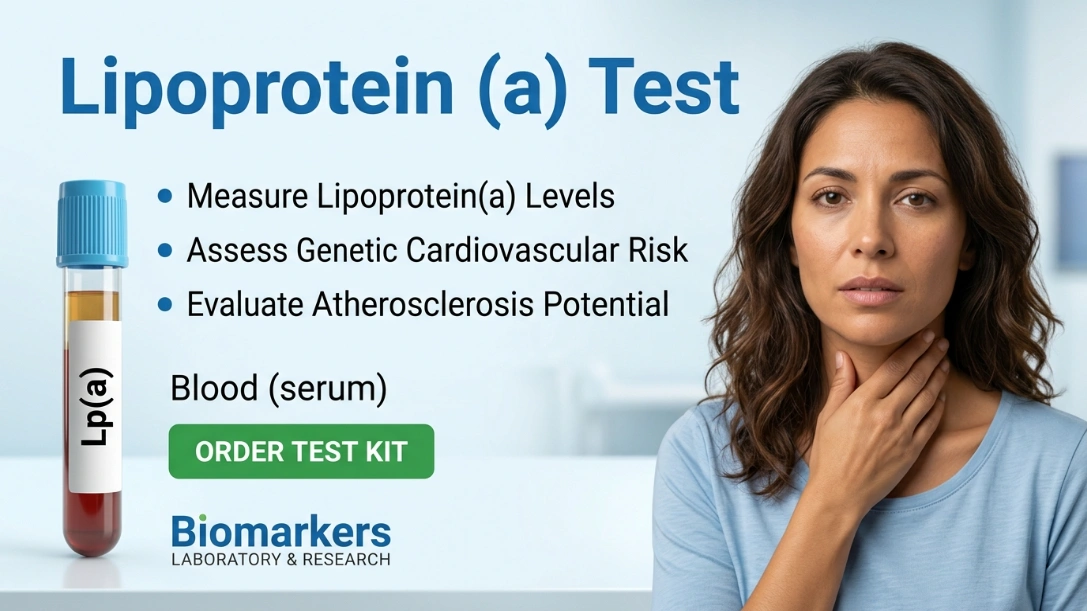
The Lipoprotein (a) Test from BiomarkersLabs.com measures the serum concentration of Lipoprotein (a) — written as Lp(a) and pronounced “L-P-little-a” — one of the most clinically significant yet systematically under-measured cardiovascular risk markers in modern medicine. Lp(a) is a genetically determined atherogenic and prothrombotic lipoprotein that is entirely distinct from LDL in structure, biology, and clinical implication. Elevated Lp(a) is an independent, causal cardiovascular risk factor — not merely a risk marker — with Mendelian randomisation studies and large-scale genetic analyses confirming that elevated Lp(a) directly drives atherosclerotic cardiovascular disease, aortic valve calcification, and ischaemic stroke through mechanisms that are entirely independent of LDL cholesterol, HDL cholesterol, triglycerides, blood pressure, and all other established risk factors. Specimens are processed through CLIA-certified partner laboratories (Quest Diagnostics and LabCorp) for USA orders, with IVDR-compliant partner laboratories serving EU and UK practitioners. Results are delivered to your secure BiomarkersLabs.com practitioner portal within 3–5 business days of specimen receipt.
Lp(a) is structurally an LDL-like particle with an additional protein — apolipoprotein(a), written as apo(a) — covalently attached to ApoB via a disulphide bond. Apo(a) is encoded by the LPA gene and is structurally homologous to plasminogen — the key fibrinolytic enzyme — which explains why elevated Lp(a) confers both atherogenic and thrombotic risk simultaneously. Lp(a) promotes atherogenesis by carrying oxidised phospholipids into the arterial wall and promoting macrophage foam cell formation; it promotes thrombosis by competitively inhibiting plasminogen binding to fibrin, impairing clot dissolution; and it promotes aortic valve calcification through its pro-inflammatory oxidised phospholipid cargo. Critically, Lp(a) concentration is determined almost entirely by genetics — specifically by the number of kringle IV type 2 repeats in the LPA gene — and is therefore stable throughout adult life, largely unaffected by diet, exercise, or most lipid-lowering medications including statins. This genetic determination means that a single Lp(a) measurement in adulthood provides a lifelong cardiovascular risk data point that does not require serial monitoring under normal circumstances.
Approximately 20% of the global population carries Lp(a) levels above 50 mg/dL (above 125 nmol/L) — the threshold associated with substantially elevated cardiovascular risk — representing over one billion individuals worldwide with an unrecognised independent cardiovascular risk factor that their standard lipid panel has never captured. The 2023 ESC/EAS Dyslipidaemia Guidelines recommend that every adult should have Lp(a) measured at least once in their lifetime. The European Atherosclerosis Society consensus statement positions elevated Lp(a) as a major causal risk factor for cardiovascular disease and aortic stenosis. The ACC/AHA identify Lp(a) above 50 mg/dL as a risk-enhancing factor that should inform treatment decisions in primary prevention. Despite this evidence base, Lp(a) is routinely absent from standard lipid panels — making this test one of the most impactful single additions a practitioner can make to a cardiovascular risk workup. CLIA-certified (USA) and IVDR-compliant (EU/UK). Licensed practitioners only through BiomarkersLabs.com.
What does this test measure?
Lipoprotein (a) — Lp(a) — The serum concentration of Lipoprotein (a), reported in mg/dL or nmol/L depending on the assay and laboratory. Both units are in clinical use and the conversion between them is not straightforward due to the variable size of the apo(a) isoform — nmol/L reporting is preferred by the European Atherosclerosis Society and ESC/EAS as it is isoform-size independent and therefore more biologically accurate. Where both units are reported, nmol/L is the primary clinical reference. The ESC/EAS define elevated Lp(a) as above 50 mg/dL (above 125 nmol/L) — a threshold above which cardiovascular risk is substantially and independently elevated. Very high Lp(a) above 180 mg/dL (above 430 nmol/L) confers a lifetime cardiovascular risk equivalent to that of heterozygous familial hypercholesterolaemia. Because Lp(a) is genetically determined and stable throughout adult life, a single measurement is sufficient for baseline cardiovascular risk stratification — repeat testing is not required unless the result falls near the clinical decision threshold and repeat confirmation is clinically warranted.
Clinical indications
Elevated cardiovascular risk with normal or adequately treated standard lipid panel — Lp(a) is the most important cardiovascular risk marker absent from standard lipid panels; patients with well-controlled LDL-C, adequate HDL, and normal triglycerides who continue to have cardiovascular events or subclinical atherosclerosis progression should have Lp(a) measured to identify this independent causal risk factor.
Family history of premature cardiovascular disease or stroke — first-degree relatives of patients who experienced myocardial infarction, stroke, coronary artery disease, or aortic stenosis before age 55 in men or age 65 in women should have Lp(a) measured; Lp(a) elevation is heritable and co-segregates with premature cardiovascular events in affected families.
Recurrent cardiovascular events despite optimised lipid therapy — patients who have had multiple cardiovascular events despite being on high-intensity statin therapy and achieving LDL-C targets should have Lp(a) measured; elevated Lp(a) is a common and clinically actionable explanation for residual cardiovascular risk that persists despite conventional therapy.
Pre-treatment Lp(a) baseline for cardiovascular risk stratification — measuring Lp(a) before initiating or intensifying lipid-lowering therapy provides the most complete cardiovascular risk baseline; a high Lp(a) at baseline shifts the overall risk estimate upward and may influence decisions about LDL-C treatment targets, aspirin use, and referral for specialist cardiovascular review.
Suspected familial hypercholesterolaemia risk modifier assessment — patients diagnosed with or suspected of having familial hypercholesterolaemia should have Lp(a) measured as a risk modifier; Lp(a) elevation in an FH patient substantially increases their already elevated cardiovascular risk and informs the urgency of LDL-C target attainment.
Universal once-in-a-lifetime cardiovascular risk screening — the ESC/EAS 2023 guidelines recommend that every adult should have Lp(a) measured at least once; a single Lp(a) result provides a lifelong independent cardiovascular risk data point and is one of the most cost-efficient additions to any cardiovascular risk assessment.
Aortic valve disease assessment and cardiovascular risk co-evaluation — Lp(a) is a causal risk factor for aortic valve calcification and stenosis progression; patients with aortic sclerosis, early aortic stenosis, or a family history of aortic valve disease should have Lp(a) measured as part of their comprehensive cardiovascular risk assessment.
Intermediate cardiovascular risk patients requiring risk reclassification — patients in the intermediate risk category on standard cardiovascular risk calculators (10-year ASCVD risk 7.5–20%) where the treatment decision is uncertain benefit from Lp(a) measurement; elevated Lp(a) in an intermediate-risk patient reclassifies them to high risk and supports more intensive preventive intervention.
Young patients with unexplained myocardial infarction or stroke — cardiovascular events in patients under 50 without traditional risk factors should prompt Lp(a) measurement alongside other thrombophilia and lipoprotein investigations; Lp(a) elevation is a common finding in premature atherosclerotic events in young adults.
Pre-conception and pregnancy cardiovascular risk assessment — women with elevated Lp(a) have increased cardiovascular risk throughout life, with the post-menopausal period being the period of greatest risk amplification; establishing Lp(a) baseline in women of reproductive age enables long-term cardiovascular risk planning.
Monitoring Lp(a)-specific therapeutic intervention — novel Lp(a)-lowering therapies including pelacarsen (an antisense oligonucleotide targeting LPA mRNA) and olpasiran and zerlasiran (small interfering RNA therapies targeting hepatic LPA expression) are in advanced clinical trials and regulatory review; practitioners following patients in Lp(a)-specific trials or early access programmes require baseline and on-treatment Lp(a) measurements to assess therapeutic response.
Sample type and collection
Sample Type: Blood (serum)
Fasting Required: Yes — 9–12 hours fasting is recommended prior to collection. Lp(a) itself is relatively stable in the fed and fasted states — its concentration is determined genetically rather than metabolically, and dietary fat has minimal direct effect on Lp(a) levels. However, fasting is standard practice when ordering Lp(a) alongside other lipid markers to ensure full dataset consistency and to enable accurate triglyceride and VLDL measurement if concurrent lipid testing is ordered.
Collection Method: Venepuncture at an approved collection site. USA patients attend a Quest Diagnostics or LabCorp patient service centre using the requisition generated through your BiomarkersLabs.com portal. EU, UK, and Canada patients are directed to partner collection networks in their region.
Specimen Timing Note: Unlike most lipid markers, Lp(a) does not require deferral after acute illness in the same way that cholesterol and triglycerides do — Lp(a) is genetically determined and its concentration is not substantially affected by the acute phase response. A single measurement at any stable time point is sufficient for lifetime cardiovascular risk stratification. However, if concurrent lipid markers are being ordered for baseline cardiovascular risk assessment, collection should be deferred until the patient is in a stable metabolic state for consistency of the full result set.
Turnaround time
3–5 business days from specimen receipt at the processing laboratory. Turnaround begins upon confirmed specimen receipt — not from the date of patient collection. The ordering practitioner receives an automated email notification when results are available in their BiomarkersLabs.com practitioner portal. Results are never sent to the patient and are not accessible outside the verified practitioner portal.
Availability
USA · EU · UK · Canada
Available to licensed practitioners ordering for patients in all US states. This test does not carry a New York state restriction — it can be ordered for patients in New York without limitation. For EU, UK, and Canadian practitioners, ordering and collection logistics are managed through your BiomarkersLabs.com portal on registration.
Compliance and certifications
CLIA Certified — All USA specimens processed by CLIA-certified Quest Diagnostics and LabCorp partner laboratories meeting federal standards for clinical laboratory quality.
IVDR Compliant — EU and UK specimens processed in compliance with the EU In Vitro Diagnostic Regulation (EU) 2017/746.
CE Marked — All diagnostic assays used for EU and UK specimens carry CE marking confirming conformity with applicable European IVD standards.
HIPAA Compliant — All USA patient data handled in full compliance with HIPAA. Results delivered to the ordering practitioner’s portal only — never to the patient.
GDPR Compliant — All EU and UK practitioner and patient data processed in accordance with the General Data Protection Regulation.
PIPEDA Compliant — Canadian data handled in compliance with the Personal Information Protection and Electronic Documents Act.
How to order
This test is available exclusively to licensed healthcare practitioners. Register free at BiomarkersLabs.com — licence verification takes 1–2 business days. USA practitioners with a valid NPI number are verified automatically. Once your account is active, search for the Lipoprotein (a) Test in your portal, enter patient details, and submit the order. Your patient receives a requisition to attend their nearest approved collection site. Results are returned to your portal within 3–5 business days of specimen receipt. All pricing is visible after login — no subscription required, pay per test.
This test is available exclusively to licensed healthcare practitioners. Results are delivered to the ordering practitioner’s secure portal only — never directly to patients. Licence verification required (1–2 business days). BiomarkersLabs.com does not accept patient self-referrals.
Frequently Asked Questions — Lipoprotein (a) Test
What is Lipoprotein (a) and why does it matter for cardiovascular risk?
Lipoprotein (a) — Lp(a) — is a genetically determined atherogenic and prothrombotic lipoprotein consisting of an LDL-like particle with an additional protein called apolipoprotein(a) covalently attached to ApoB. Lp(a) drives cardiovascular disease through three distinct mechanisms: it promotes atherogenesis by depositing oxidised phospholipids in arterial walls; it impairs fibrinolysis by competitively inhibiting plasminogen binding to fibrin, increasing thrombotic risk; and it promotes aortic valve calcification through its inflammatory oxidised phospholipid cargo. Elevated Lp(a) is an independent causal cardiovascular risk factor confirmed by Mendelian randomisation — meaning high Lp(a) directly causes cardiovascular disease, not merely associates with it.
What Lp(a) level is considered elevated and high risk?
The ESC/EAS and European Atherosclerosis Society define elevated Lp(a) as above 50 mg/dL (above 125 nmol/L) — the threshold above which cardiovascular and aortic valve disease risk is substantially and independently elevated. The ACC/AHA identify Lp(a) above 50 mg/dL as a risk-enhancing factor in primary prevention cardiovascular risk assessment. Very high Lp(a) above 180 mg/dL (above 430 nmol/L) confers a cardiovascular risk burden equivalent to heterozygous familial hypercholesterolaemia. Approximately 20% of the global population — over one billion individuals — carries Lp(a) above 50 mg/dL.
Why is Lp(a) not included in the standard lipid panel?
Standard lipid panels — measuring total cholesterol, LDL, HDL, and triglycerides — were designed and validated decades before the causal role of Lp(a) was fully established. Lp(a) measurement historically required specialist laboratory methods, and the absence of approved Lp(a)-lowering therapies meant that measuring it was considered less actionable. Both of these barriers have now been substantially reduced — Lp(a) measurement is widely available through CLIA-certified reference laboratories, and novel specific Lp(a)-lowering therapies are in advanced clinical trials. The 2023 ESC/EAS guidelines now explicitly recommend once-in-a-lifetime Lp(a) screening for all adults, and leading cardiovascular societies are increasingly calling for Lp(a) to be incorporated into routine lipid assessment.
Does Lp(a) change with diet, exercise, or statins?
No — Lp(a) concentration is determined almost entirely by genetics, specifically by variation in the LPA gene encoding apolipoprotein(a). Diet, aerobic exercise, and body weight have minimal direct effect on Lp(a) levels. Statins do not lower Lp(a) — in fact, some data suggest statins may modestly raise Lp(a) by upregulating LDL receptor activity, which preferentially clears LDL over Lp(a). Niacin lowers Lp(a) by approximately 20–30% but is not approved for cardiovascular risk reduction in most guidelines due to trial data showing no benefit despite LDL and Lp(a) lowering. PCSK9 inhibitors lower Lp(a) by approximately 25–30%. The most effective Lp(a)-specific therapies are pelacarsen, olpasiran, and zerlasiran — which lower Lp(a) by 70–98% in clinical trials and are in late-stage regulatory review.
Do I need to repeat the Lp(a) test over time?
In most patients, a single Lp(a) measurement is sufficient for lifetime cardiovascular risk stratification. Lp(a) is genetically determined and remains stable throughout adult life — it does not fluctuate meaningfully with diet, lifestyle, metabolic changes, or most medications. Serial monitoring is not routinely required. Repeat testing may be appropriate if the initial result falls near the clinical decision threshold of 50 mg/dL and confirmation is warranted, or if a patient is enrolled in an Lp(a)-specific therapeutic trial or programme where on-treatment Lp(a) reduction needs to be quantified.
How does Lp(a) relate to familial hypercholesterolaemia?
Lp(a) elevation and familial hypercholesterolaemia are independent genetic cardiovascular risk factors that frequently co-occur. FH is caused by mutations in the LDLR, APOB, or PCSK9 genes producing markedly elevated LDL from birth. Elevated Lp(a) is an additional independent risk modifier in FH patients — those with both FH and elevated Lp(a) have a substantially higher cardiovascular event rate than those with FH alone. ESC/EAS guidelines recommend measuring Lp(a) in all patients with suspected or confirmed FH as part of their comprehensive cardiovascular risk characterisation, as elevated Lp(a) in an FH patient warrants more aggressive LDL-C target setting and earlier consideration of PCSK9 inhibitor therapy.
Which laboratory processes the Lipoprotein (a) test on BiomarkersLabs.com?
For USA practitioners, Lp(a) specimens are processed by Quest Diagnostics or LabCorp — CLIA-certified national reference laboratories. Your patient attends their nearest Quest or LabCorp patient service centre using the requisition generated through your BiomarkersLabs.com portal. For EU, UK, and Canadian practitioners, specimens are processed by IVDR-compliant regional partner laboratories. All processing details are confirmed in your portal at the point of ordering.
Is the Lipoprotein (a) test available for patients in New York state?
Yes. The Lipoprotein (a) test does not carry a New York state restriction. Licensed practitioners in New York can order this test for their patients without limitation through BiomarkersLabs.com.
How quickly will Lipoprotein (a) results be available in my practitioner portal?
Results are available in your BiomarkersLabs.com practitioner portal within 3–5 business days from confirmed specimen receipt at the processing laboratory. You receive an automated email notification when results are ready. Results are accessible only through your secure verified portal — they are never sent to the patient and not accessible to anyone outside your practitioner account.


Reviews
There are no reviews yet.