

Description
What is the Cardio IQ Lipoprotein Fractionation (Ion Mobility) Test?
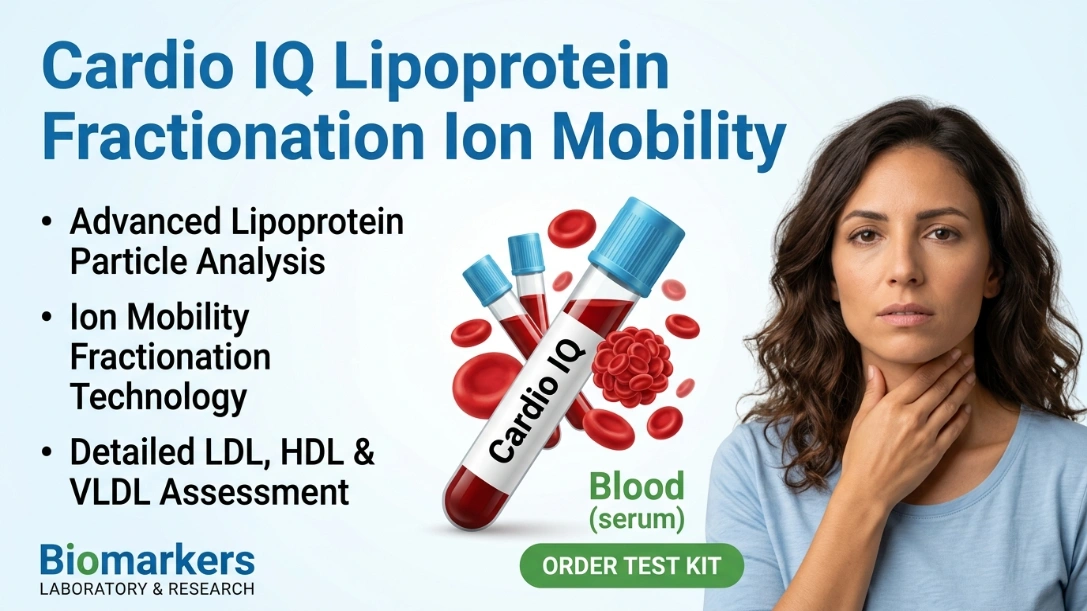
The Cardio IQ Lipoprotein Fractionation by Ion Mobility from BiomarkersLabs.com is the most analytically precise lipoprotein particle characterisation test available through the Quest Diagnostics Cardio IQ platform — using ion mobility analysis to directly measure lipoprotein particle number and size across all major lipoprotein fractions with a level of resolution that exceeds both standard lipid panels and NMR-based lipoprotein profiling. Ion mobility is a gas-phase electrophoretic separation technique that physically separates lipoprotein particles by their size and electrical mobility after converting them to the gas phase — producing a particle-by-particle count and size distribution across LDL subfractions, HDL subfractions, VLDL subfractions, and IDL with a granularity of measurement not achievable by any other clinical lipoprotein methodology. This test is processed exclusively through Quest Diagnostics’ CLIA-certified USA laboratory network and is available in the USA only. Licensed practitioners only through BiomarkersLabs.com. Results are delivered to your secure BiomarkersLabs.com practitioner portal within 5–7 business days of specimen receipt.
The clinical significance of ion mobility lipoprotein fractionation lies in its unique ability to resolve the complete LDL particle size spectrum — from the largest buoyant LDL-I particles through the intermediate LDL-II and LDL-III subfractions to the smallest and most atherogenic LDL-IV particles — with direct particle counting at each size interval rather than a single summary LDL particle number. This granular subfraction data goes beyond what NMR LipoProfile (BML-CAR-004) or standard advanced lipid panels provide — it identifies not just that a patient has a high LDL particle number, but specifically which LDL subfraction is driving that elevation, and whether the predominant LDL phenotype is Pattern A (predominantly large buoyant LDL — lower atherogenicity) or Pattern B (predominantly small dense LDL — substantially higher atherogenicity, stronger predictor of cardiovascular events). The same subfraction resolution applies to HDL particles, where large HDL particles are most cardioprotective and small HDL particles contribute less to reverse cholesterol transport, and to VLDL and IDL where remnant particle accumulation is directly quantified rather than estimated.
Ion mobility technology was developed and validated at Quest Diagnostics and represents the current analytical gold standard for lipoprotein particle characterisation in clinical laboratory practice. The methodology’s advantages over NMR include direct physical particle separation rather than NMR signal deconvolution, independent particle number and size measurement for each subfraction rather than averaged estimates, and the ability to resolve particle subclasses that overlap spectrally in NMR. For practitioners requiring the most definitive possible lipoprotein particle characterisation — particularly in high-risk patients with complex or discordant lipid profiles, patients being managed on intensive lipid-lowering therapy, and cases where standard and NMR-based lipid assessment has been insufficient to fully explain cardiovascular risk — the Cardio IQ Lipoprotein Fractionation by Ion Mobility represents the highest resolution cardiovascular lipid assessment available in routine clinical practice. CLIA-certified (USA). USA only. Licensed practitioners only through BiomarkersLabs.com.
What does this test measure?
LDL Particle Number (LDL-P) — Total LDL particle count by direct ion mobility measurement across all LDL subfractions. The most accurate direct count of total atherogenic LDL particle burden available, free from NMR signal overlap or algorithmic estimation.
LDL Particle Size — Mean LDL particle diameter and LDL subfraction distribution across LDL-I (large buoyant), LDL-II (medium), LDL-III (small dense), and LDL-IV (very small dense) size classes. Identification of Pattern A (predominantly large buoyant LDL) versus Pattern B (predominantly small dense LDL — higher atherogenic risk) phenotype.
HDL Particle Number (HDL-P) — Total HDL particle count and subfraction distribution across large, medium, and small HDL size classes. Large HDL particles are most effective at facilitating reverse cholesterol transport; small HDL particles contribute less to cardioprotection despite contributing to total HDL-C concentration.
HDL Particle Size — Mean HDL diameter and subfraction characterisation identifying the quality of the HDL particle pool beyond simple HDL cholesterol concentration.
VLDL Particle Number — Direct count of VLDL particles across VLDL subfractions, quantifying triglyceride-rich lipoprotein burden and atherogenic remnant particle contribution.
IDL (Intermediate-Density Lipoprotein) Particle Number — Direct quantification of IDL particles — the remnant lipoproteins produced by partial VLDL lipolysis that are highly atherogenic and frequently missed by standard lipid panels and NMR-based testing.
LDL Cholesterol — Standard calculated LDL cholesterol value included for guideline-based comparison and treatment threshold reference alongside the particle data.
Clinical indications
Definitive cardiovascular risk stratification by ion mobility methodology — ion mobility provides the highest resolution direct lipoprotein particle counting available in clinical practice, enabling definitive cardiovascular risk characterisation in high-risk patients where lower-resolution methods have been insufficient to fully quantify atherogenic burden.
Statin residual risk assessment via particle analysis — statin-treated patients who remain at elevated cardiovascular risk despite achieving LDL-C targets benefit from ion mobility fractionation to identify whether persistent LDL particle number elevation, small dense LDL subfraction predominance, IDL accumulation, or low HDL particle number is driving residual risk.
Unexplained cardiovascular events with normal standard lipids — patients who have experienced myocardial infarction, stroke, or significant coronary artery disease with normal or near-normal LDL cholesterol should have ion mobility fractionation to identify the elevated atherogenic particle burden that their LDL-C has not captured.
Advanced atherogenic dyslipidaemia assessment — patients with metabolic syndrome, insulin resistance, type 2 diabetes, or hypertriglyceridaemia characterised by the atherogenic triad of elevated small dense LDL, low HDL, and elevated triglycerides benefit from the complete subfraction resolution that ion mobility provides — identifying the full extent of LDL Pattern B predominance and remnant particle accumulation.
LDL Pattern A versus Pattern B phenotype determination — ion mobility is the gold standard methodology for definitively classifying a patient’s LDL phenotype as Pattern A (predominantly large, buoyant LDL — lower atherogenicity) or Pattern B (predominantly small, dense LDL — substantially higher atherogenicity and independent predictor of cardiovascular events); this classification is clinically actionable and informs both therapeutic intensity and the choice of lipid-lowering intervention.
IDL quantification for remnant particle cardiovascular risk — IDL particles are highly atherogenic, are produced by partial VLDL lipolysis, and accumulate in type III hyperlipoproteinaemia and states of impaired remnant clearance; ion mobility directly counts IDL particles that are undetectable or underestimated by standard lipid panels and NMR fractionation.
Monitoring intensive lipid-lowering therapy at the particle level — patients on combination therapy including statins, PCSK9 inhibitors, ezetimibe, or bempedoic acid benefit from the highest resolution particle monitoring available to confirm that particle number and size distribution are shifting as expected; LDL-C alone may reach target while LDL particle number and Pattern B phenotype persist.
HDL particle quality assessment beyond HDL cholesterol — patients with seemingly adequate HDL-C but persistent cardiovascular risk may have a predominantly small HDL particle distribution with impaired reverse cholesterol transport capacity; ion mobility identifies this qualitative HDL deficit that HDL-C and even ApoA-1 alone do not fully resolve.
Complex dyslipidaemia requiring highest resolution characterisation — patients with simultaneous abnormalities across multiple lipoprotein fractions — elevated LDL-P, IDL accumulation, Pattern B LDL, small HDL, and elevated VLDL — require the comprehensive multi-fraction direct counting that ion mobility uniquely provides to fully characterise their atherogenic burden and guide multi-targeted therapy.
Familial hypercholesterolaemia and familial combined hyperlipidaemia advanced particle profiling — genetic dyslipdaemias produce characteristic particle distribution abnormalities that ion mobility resolves with greater precision than any alternative method, enabling more accurate particle-level treatment target setting and monitoring.
Cardiovascular risk discordance resolution — in patients where LDL-C, non-HDL cholesterol, ApoB, and NMR-based particle data produce conflicting or uncertain risk signals, ion mobility fractionation serves as the definitive arbitrator of true atherogenic particle burden, resolving discordance through direct physical particle separation and counting.
Sample type and collection
Sample Type: Blood (serum)
Fasting Required: Yes — 9–12 hours fasting is mandatory prior to collection. Fasting is essential for ion mobility lipoprotein fractionation because post-prandial chylomicron and chylomicron remnant particles overlap with VLDL and IDL in the ion mobility separation spectrum, leading to significant overestimation of atherogenic remnant particle burden if the patient has eaten within the preceding 9–12 hours. Strict fasting compliance is particularly critical for this test given the granular subfraction resolution — even partial dietary fat absorption can materially affect IDL and VLDL subfraction counts and distort LDL subfraction distribution. Patients should consume no caloric food or beverages for the full 9–12 hour window. Water is permitted and encouraged.
Collection Method: Venepuncture at an approved collection site. USA patients attend a Quest Diagnostics patient service centre using the requisition generated through your BiomarkersLabs.com portal. This test is processed exclusively through Quest Diagnostics’ USA laboratory network — LabCorp collection sites are not applicable for this specific test. Practitioners should confirm Quest Diagnostics collection site attendance with their patient at the point of ordering.
Specimen Timing Note: Avoid collection during acute illness, hospitalisation, or within six weeks of a major cardiovascular event — lipoprotein particle concentrations and distributions are acutely altered by the inflammatory response and do not reflect the patient’s true stable cardiovascular risk state. Acute illness causes shifts in LDL subfraction distribution that are not representative of the chronic atherogenic burden. For patients on lipid-lowering therapy, collect at a consistent time relative to medication dosing for valid serial comparisons.
Turnaround time
5–7 business days from specimen receipt at Quest Diagnostics’ processing laboratory. Turnaround begins upon confirmed specimen receipt — not from the date of patient collection. Ion mobility analysis requires additional analytical processing steps relative to standard lipid assays, which accounts for the longer turnaround compared to basic lipid markers. The ordering practitioner receives an automated email notification when results are available in their BiomarkersLabs.com practitioner portal. Results are never sent to the patient and are not accessible outside the verified practitioner portal.
Availability
USA only
This test is processed exclusively through Quest Diagnostics’ CLIA-certified USA laboratory network using validated ion mobility technology. It is not available for EU, UK, or Canadian practitioners through BiomarkersLabs.com. Practitioners outside the USA requiring advanced lipoprotein fractionation should consider the Expanded Lipid Panel (BML-CAR-005) or the ApoB/ApoA-1 Ratio Panel (BML-CAR-012), which are available globally. USA practitioners can order for patients in all US states. This test does not carry a New York state restriction — it can be ordered for patients in New York without limitation.
Compliance and certifications
CLIA Certified — All specimens processed by Quest Diagnostics CLIA-certified USA laboratories meeting federal standards for clinical laboratory quality.
HIPAA Compliant — All USA patient data handled in full compliance with HIPAA. Results delivered to the ordering practitioner’s portal only — never to the patient.
How to order
This test is available exclusively to licensed healthcare practitioners in the USA. Register free at BiomarkersLabs.com — licence verification takes 1–2 business days. USA practitioners with a valid NPI number are verified automatically. Once your account is active, search for the Cardio IQ Lipoprotein Fractionation (Ion Mobility) test in your portal, enter patient details, and submit the order. Your patient receives a requisition to attend their nearest Quest Diagnostics patient service centre — fasting for 9–12 hours before collection is mandatory. Results are returned to your portal within 5–7 business days of specimen receipt. All pricing is visible after login — no subscription required, pay per test.
This test is available exclusively to licensed healthcare practitioners. Results are delivered to the ordering practitioner’s secure portal only — never directly to patients. Licence verification required (1–2 business days). BiomarkersLabs.com does not accept patient self-referrals.
Frequently Asked Questions — Cardio IQ Lipoprotein Fractionation (Ion Mobility)
What is ion mobility and how does it differ from NMR lipoprotein testing?
Ion mobility is a gas-phase electrophoretic particle separation technique that physically separates lipoprotein particles by their electrical mobility and size after converting them to the gas phase, producing a direct particle-by-particle count and size distribution across all lipoprotein subfractions. NMR (nuclear magnetic resonance) lipoprotein profiling estimates particle number and size by analysing the combined NMR signal of all lipoprotein particles in a serum sample and mathematically deconvoluting that signal into size subclasses. The fundamental difference is that ion mobility physically separates and directly counts particles, while NMR estimates particle characteristics from a composite spectral signal. Ion mobility produces independent particle number and size data for each subfraction — including granular LDL subfractions (LDL-I, LDL-II, LDL-III, LDL-IV) and direct IDL quantification — at a resolution that NMR spectral deconvolution cannot match for subfractions that overlap spectrally.
What is LDL Pattern A versus Pattern B and why does it matter?
LDL Pattern A describes a lipid phenotype characterised by predominantly large, buoyant LDL particles — the LDL-I and LDL-II subfractions. Pattern B describes a phenotype characterised by predominantly small, dense LDL particles — the LDL-III and LDL-IV subfractions. Small dense LDL particles are substantially more atherogenic than large buoyant LDL for several reasons: they penetrate the arterial wall more readily due to their smaller diameter; they have lower affinity for the LDL receptor and therefore circulate longer before clearance; they are more susceptible to oxidative modification, and oxidised LDL is the primary driver of macrophage foam cell formation; and they carry less cholesterol per particle, meaning a patient with Pattern B has more particles for the same LDL-C value than a Pattern A patient. Ion mobility is the definitive methodology for LDL pattern classification and provides the granular subfraction distribution data needed to make this classification with confidence.
What is IDL and why is direct IDL quantification clinically important?
Intermediate-Density Lipoprotein — IDL — is a remnant lipoprotein produced when lipoprotein lipase partially hydrolyses VLDL, removing some but not all of its triglyceride content. IDL can be either further processed to LDL by hepatic lipase or cleared directly by LDL receptors in the liver. IDL is highly atherogenic — it penetrates arterial walls, contributes to foam cell formation, and accumulates substantially in type III hyperlipoproteinaemia, insulin resistance, and metabolic syndrome. Standard lipid panels do not measure IDL — it is absorbed into the calculated LDL cholesterol value or missed entirely. NMR fractionation provides a combined IDL and VLDL estimate rather than a clean IDL-specific count. Ion mobility directly counts IDL particles separately from LDL and VLDL, providing unique clinical data on remnant particle burden that no other routine clinical test captures with equivalent precision.
How does ion mobility compare to the NMR LipoProfile (BML-CAR-004)?
Both tests measure lipoprotein particle number and provide LDL particle subclass data. The NMR LipoProfile (BML-CAR-004) uses NMR spectroscopy and is widely validated, extensively published, and available through LabCorp. The Cardio IQ Ion Mobility test uses physical electrophoretic particle separation through Quest Diagnostics and provides greater subfraction resolution — particularly for LDL subclasses (LDL-I through LDL-IV individually) and direct IDL quantification. For most clinical applications — including LDL-C and LDL-P discordance, metabolic syndrome particle assessment, and statin monitoring — either test provides sufficient clinical information. Ion mobility is preferred when the highest possible subfraction resolution is required, when IDL quantification is specifically needed, or when the practitioner requires definitive LDL pattern classification beyond what summary particle number and size data provides.
Why is this test USA only?
The Cardio IQ Lipoprotein Fractionation by Ion Mobility is processed exclusively through Quest Diagnostics’ specialised USA laboratory network using validated ion mobility instrumentation. Ion mobility technology has been developed and scaled by Quest Diagnostics specifically for the USA clinical laboratory market and is not currently available through Quest Diagnostics’ international laboratory partners or through alternative laboratory networks serving EU, UK, and Canadian practitioners. Practitioners outside the USA who require advanced lipoprotein fractionation should consider the NMR LipoProfile alternatives, the Expanded Lipid Panel (BML-CAR-005), or the apolipoprotein-based panels (BML-CAR-011, BML-CAR-012) which are globally available.
Which laboratory processes this test?
The Cardio IQ Lipoprotein Fractionation (Ion Mobility) is processed exclusively by Quest Diagnostics — a CLIA-certified national reference laboratory — using their validated ion mobility platform. Patients must attend a Quest Diagnostics patient service centre for collection using the requisition generated through your BiomarkersLabs.com portal. This test cannot be collected at LabCorp sites. All processing details are confirmed in your portal at the point of ordering.
Is this test available for patients in New York state?
Yes. The Cardio IQ Lipoprotein Fractionation (Ion Mobility) does not carry a New York state restriction. Licensed practitioners in New York can order this test for their patients without limitation through BiomarkersLabs.com.
How quickly will results be available in my practitioner portal?
Results are available in your BiomarkersLabs.com practitioner portal within 5–7 business days from confirmed specimen receipt at Quest Diagnostics’ processing laboratory. Ion mobility analysis requires additional analytical steps relative to standard lipid assays. You receive an automated email notification when results are ready. Results are accessible only through your secure verified portal — they are never sent to the patient and not accessible to anyone outside your practitioner account.



Reviews
There are no reviews yet.