

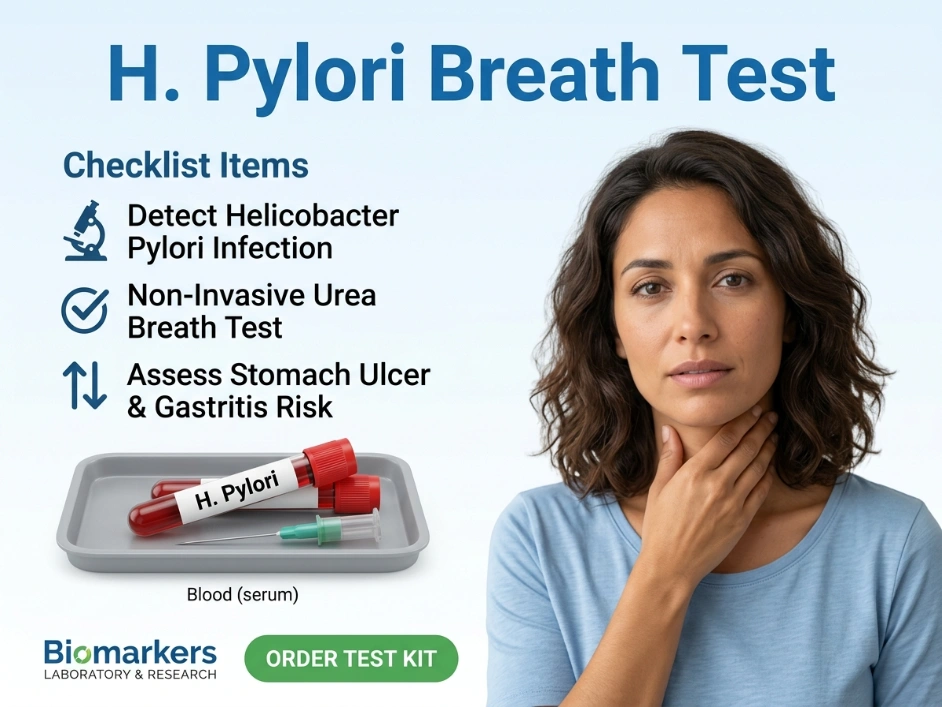
Description
What is the H. Pylori Breath Test?
The H. Pylori Breath Test from BiomarkersLabs.com is the most accurate non-invasive diagnostic test available for active Helicobacter pylori infection — using the urea breath test (UBT) methodology to directly detect H. pylori urease enzyme activity in the stomach. H. pylori is a gram-negative spiral bacterium that colonises the gastric mucosa of approximately 44% of the global population and is the primary cause of peptic ulcer disease, chronic active gastritis, and — in a subset of infected individuals — gastric adenocarcinoma and MALT lymphoma. It is classified as a Group I carcinogen by the World Health Organisation. The urea breath test exploits the exceptionally high urease enzyme activity of H. pylori — the bacteria produce urease to hydrolyse urea in the stomach to carbon dioxide and ammonia, creating an ammonia buffer that raises local gastric pH and enables the bacteria to survive the acid environment. In the UBT, the patient ingests a capsule or solution containing isotopically labelled urea (¹³C-urea — a stable non-radioactive carbon isotope). If H. pylori is present in the stomach, its urease immediately hydrolyses the ¹³C-urea, releasing ¹³CO₂ that is absorbed into the bloodstream and exhaled in breath — where it is detected and quantified by isotope ratio mass spectrometry. A positive ¹³CO₂ result confirms active H. pylori urease activity and therefore active infection. Specimens are processed through CLIA-certified partner laboratories. Results delivered within 3–5 business days. Available in USA · EU · UK · Canada. Licensed practitioners only.
The urea breath test is the gold-standard non-invasive test for both initial H. pylori diagnosis and post-eradication confirmation — outperforming H. pylori serology (which cannot distinguish active from past infection), stool antigen testing (which is slightly less sensitive), and culture (which requires invasive endoscopic biopsy). The UBT’s sensitivity and specificity both exceed 95% for active H. pylori infection when performed under correct conditions — with specific requirements for prior medication washout periods. Proton pump inhibitors (PPIs) and H₂-receptor antagonists suppress gastric acid and substantially reduce H. pylori urease activity, producing false-negative UBT results in patients who remain on acid suppression therapy. PPIs must be discontinued for a minimum of 2 weeks and antibiotics for a minimum of 4 weeks before UBT to ensure adequate urease activity for accurate detection. The UBT is the preferred initial diagnostic test for H. pylori over serology in symptomatic patients because it confirms active infection rather than merely past exposure. Licensed practitioners only through BiomarkersLabs.com.
What does this test measure?
¹³CO₂ in exhaled breath — measured by isotope ratio mass spectrometry as the ratio of ¹³CO₂ to ¹²CO₂ in post-urea ingestion breath samples compared to baseline. A significant rise in ¹³CO₂ above the cut-off threshold (typically expressed as delta over baseline — DOB — with DOB above 4‰ indicating positive H. pylori urease activity) confirms active H. pylori infection. A negative result indicates absence of active H. pylori urease activity and effectively excludes current H. pylori infection in a correctly prepared patient.
Clinical indications
H. pylori diagnosis in symptomatic patients — the preferred non-invasive initial test for active H. pylori infection in patients with dyspepsia, epigastric pain, peptic ulcer disease, or H. pylori-associated symptoms.
Post-eradication confirmation of successful H. pylori treatment — the UBT is the gold standard for confirming H. pylori eradication after antibiotic therapy; performed a minimum of 4 weeks after completing eradication therapy and 2 weeks after stopping PPIs; a negative result confirms successful eradication.
Suspected peptic ulcer disease — H. pylori eradication heals most non-NSAID peptic ulcers and prevents recurrence; UBT confirmation of active infection is required before initiating eradication therapy.
Dyspepsia investigation — test-and-treat strategy using UBT for H. pylori in uninvestigated dyspepsia is endorsed by guidelines in patients under 55 without alarm features as an alternative to early endoscopy.
H. pylori screening in first-degree relatives of gastric cancer patients — gastric cancer risk is elevated in first-degree relatives of patients with gastric adenocarcinoma; H. pylori eradication reduces gastric cancer risk and screening is recommended in high-risk families.
Non-invasive preferred method over stool antigen for initial diagnosis — UBT provides direct functional confirmation of active infection rather than antigen detection; it is preferred over serology (which cannot distinguish active from past infection) and equivalent to or superior to stool antigen in diagnostic accuracy.
Sample type and collection
Sample Type: Exhaled breath
Fasting Required: Yes — the patient must fast for a minimum of 4 hours before the test. The test kit includes ¹³C-urea capsule or solution and breath collection bags. The patient ingests the labelled urea and provides breath samples at baseline and 30 minutes after ingestion.
Medication requirements: PPIs must be stopped for 2 weeks minimum. Antibiotics, bismuth, and metronidazole must be stopped for 4 weeks minimum. H₂ blockers must be stopped for 24 hours. Failure to observe these washout periods will produce false-negative results.
Turnaround time
3–5 business days. USA · EU · UK · Canada. No New York state restriction.
How to order
Register free at BiomarkersLabs.com. Licensed practitioners only. Pay per test.




Reviews
There are no reviews yet.