

Description
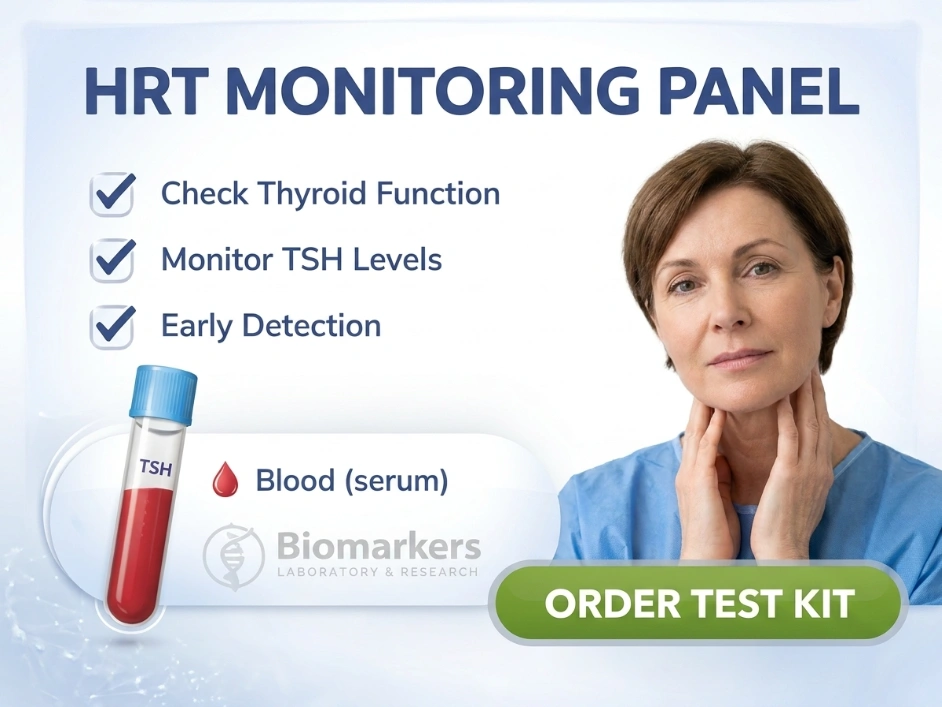
The HRT Monitoring Panel from BiomarkersLabs.com is a structured hormonal assessment panel specifically designed for monitoring women on hormone replacement therapy — whether conventional pharmaceutical HRT or compounded bioidentical HRT. Effective HRT management requires periodic laboratory monitoring to confirm that hormone levels are within the therapeutic target range, to identify under- or over-replacement, to adjust dosing in response to symptom changes, and to assess the safety markers relevant to ongoing therapy. A single symptom-based review without objective hormonal data risks dosing inaccuracy that can affect both therapeutic efficacy and long-term safety outcomes.
The panel measures the principal hormones relevant to HRT monitoring — oestradiol, progesterone (or synthetic progestogen where applicable), testosterone (where testosterone therapy is co-prescribed), SHBG, and FSH — alongside safety-relevant markers as appropriate to the patient’s age and risk profile. In women on testosterone replacement therapy, total testosterone and SHBG together with FAI calculation provide the free androgen assessment required to confirm that physiological female levels are maintained. In women on oestrogen alone or combined HRT, oestradiol alongside FSH and SHBG provides the therapeutic adequacy assessment required for dosing optimisation. Results are CLIA-certified (USA) and IVDR-compliant (EU/UK), delivered to the practitioner portal within 1–3 business days.
What does the HRT Monitoring Panel measure?
Oestradiol (E2 — 17-beta-Oestradiol) — the primary therapeutic target in oestrogen-containing HRT. Confirms therapeutic oestrogen levels are within the desired range; guides dose adjustment.
FSH (Follicle Stimulating Hormone) — in women on HRT, persistently elevated FSH despite adequate oestradiol suggests under-replacement or poor absorption; FSH suppression into the normal reproductive range confirms adequate oestrogenic effect.
Progesterone — confirmation of progesterone adequacy in women prescribed natural micronised progesterone for endometrial protection; differentiates adequate from sub-therapeutic progesterone exposure.
Total Testosterone (female high-sensitivity assay) — monitoring of testosterone replacement therapy in women prescribed transdermal testosterone; confirms levels remain within the physiological female reference range.
SHBG (Sex Hormone-Binding Globulin) — route-of-administration sensitive; oral oestrogen markedly elevates SHBG while transdermal does not; essential for free testosterone calculation and for understanding free hormone bioavailability.
Clinical indications
HRT dose adequacy monitoring — objective assessment of oestradiol and FSH to confirm that HRT is providing adequate oestrogenic replacement and achieving symptomatic and biochemical targets.
HRT dose adjustment following symptom change — when a patient on established HRT reports recurrent vasomotor symptoms, mood deterioration, or other hormonal symptoms, the monitoring panel guides dose adjustment decisions with objective data.
Testosterone replacement monitoring in women — women prescribed transdermal testosterone gel require periodic monitoring to confirm total and free testosterone levels remain within the physiological female range, preventing unintended supraphysiological exposure.
SHBG-guided free oestrogen and testosterone assessment — in women where route of administration has significantly altered SHBG (particularly those switched from oral to transdermal therapy), SHBG measurement is essential for interpreting free hormone bioavailability.
Annual HRT safety and efficacy review — routine annual monitoring panel as part of the ongoing HRT management and safety review, providing objective hormonal data to support continued prescribing decisions.
Post-initiation HRT assessment (6–8 week review) — first monitoring panel at 6–8 weeks after HRT initiation or dose change, to confirm adequate absorption and initial therapeutic response before the first clinical review.
Sample type and collection
Blood (serum). No fasting required. Venepuncture at an approved collection site. Timing of the sample relative to HRT administration is important for accurate interpretation: transdermal oestradiol should ideally be measured at least 24 hours after patch application or gel application; oral oestradiol and oral progesterone samples should be timed consistently relative to last dose. The sampling protocol should be standardised across monitoring visits for reliable trend interpretation. Testosterone should be drawn 4–6 hours after gel application for peak levels, or immediately before the next dose for trough levels.
Turnaround time
1–3 business days from specimen receipt.
Availability
USA · EU · UK · Canada
Compliance
CLIA Certified · IVDR Compliant · CE Marked · HIPAA Compliant · GDPR Compliant · PIPEDA Compliant
How to order
Register free at BiomarkersLabs.com. Licensed practitioners only. Pay per test — no subscription required. Results are delivered directly and securely to your practitioner portal and are never released directly to patients.




Reviews
There are no reviews yet.